
Ego and Soul – Balancing Vision and Ambition
I slept and dreamt that life was joy. I awoke and saw that life was service. I acted and
behold, service was joy. — Rabindranath Tagore
In examining the outcomes, actions and mindset associated with successful performance, Success
Factor Modeling also takes into account that fact that each person, team or organization are what
Arthur Koestler called a “holon.” On the one hand, they are whole and independent systems in and of
themselves. On the other hand, they are also part of successively bigger systems that include but
transcend the individual, team or organization.
Thus, Success Factor Modeling views our lives and motivations as driven by two complementary
aspects of our identities: those emerging from (1) our existence as a separate, independent whole and
those arising from (2) our existence as a part of a larger whole (e.g., family, profession, community,
etc.). The part of our existence that we experience as an individual whole we typically call our ego.
The part of our existence that we experience as a holon (part of a larger whole) can be referred to as
our soul .
According to psychoanalysis, the ego is “the part of the psyche that mediates between the
conscious and the unconscious and is responsible for reality testing and a sense of personal identity.”
Thus, the ego has to do with the development and preservation of our sense of a separate self,
perceiving reality from our own independent and isolated perspective.
At the level of environment, the ego tends to focus on dangers and constraints, and the pursuit of
short-term gain and pleasure. Consequently, at the level of behavior, the ego tends to be more
reactive to external conditions. The capabilities associated with the ego are generally those connected
with the conscious cognitive intellect such as analysis and strategy. At the level of beliefs and values
the ego focuses on safety, security, approval, control, achievement and self-benefit. A sense of
permission is typically needed in order engage fully in some activity; the sense that one should,
shouldn’t, needs to or must not do something. At the identity level, ego relates to our social roles and
who we feel we should be or need to be to get approval or acknowledgement. At the level of spirit or
purpose of the ego is oriented toward survival, recognition and ambition.
From the NLP perspective, the ego can be considered a cognitively constructed map or model of
one’s “self” as a separate entity and a natural developmental process. These notions of “reality” and
“self” associated with the ego, however, are influenced by external references such as social norms,
cultural values and family patterns. Like all maps or models, it is necessarily shaped by the processes
of deletion, distortion and generalization. When these distortions create too much disconnection and
separation from the actual territory and potential (superposition) of ourselves they can create
symptoms. Some characteristics of an unhealthy ego take the form of either self-inflation —pride,
arrogance, self-importance, narcissism and self-infatuation—or self-depreciation —self-judgment,
depression, self-criticism, lack of self-worth and self-confidence, etc. These can lead us to become
overly gripped by greed, fear and survival strategies (fight, flight, freeze).
The “soul” is a term used to refer to the deepest part of a person’s nature and is expressed as a
special quality of “emotional or intellectual energy or intensity.” The soul is the unique life force,
essence or energy that we come into the world with and that comes into the world through us. As a
newborn baby, for instance, we do not yet have an ego, but we have a unique energy and being that is
the foundation for our identity. This energy is expressed through our bodies and our interface with the
larger systems surrounding us. Because the soul is an energetic “deep structure,” it is not associated
with any particular content—and therefore is not constructed from influences such as society, culture
and family. It does, however, express itself in the form of contribution to these as larger systems.
Next Generation Entrepreneurs: Balancing Ego and Soul – Page 1 – Copyright 2024 © by Dilts Strategy Group
Thus, rather than being an objectified or separate self, the soul is our expression of an unfolding,
connected being.
At the level of environment, the soul tends to focus on opportunities for expression and
contribution. As a result, at the level of behavior the soul tends to respond more proactively to
external conditions. The capabilities associated with the soul are generally those related to the
perception and expression of energy and emotional intelligence. At the level of beliefs and values, the
soul focuses on internal motivations such as service, contribution, connection, being, expansion and
awakening. At the identity level, soul relates to our mission and the unique gifts that we bring into the
world. At the level of spirit or purpose of the soul is oriented toward our vision of what we want to
create in the world through us but that is beyond us.
From this perspective, we can say that the ego creates the “channel” through which the “vitality”
and “life force” of the soul is expressed into the world. When the ego is healthy aligned with our soul,
the channel is open. When the ego is inflated, deflated, rigid or gripped by survival strategies, the
channel is constricted or closed.
From the perspective of Success Factor Modeling, both of these aspects, ego and soul, are
necessary for a healthy and successful existence. The primary questions relating to our ego are about
what we want to achieve for ourselves in terms our ambition and role : “What type of life do I want to
create for myself?” and “What type of person do I need to be in order to create the life I want?” These
are about living out our dreams for ourselves. The primary questions with respect to the soul are
those related to our vision and mission for the larger systems of which we are a part: “What do I want
to create in the world through me that is beyond me?” and “What is my unique contribution to
bringing that vision into expression?”
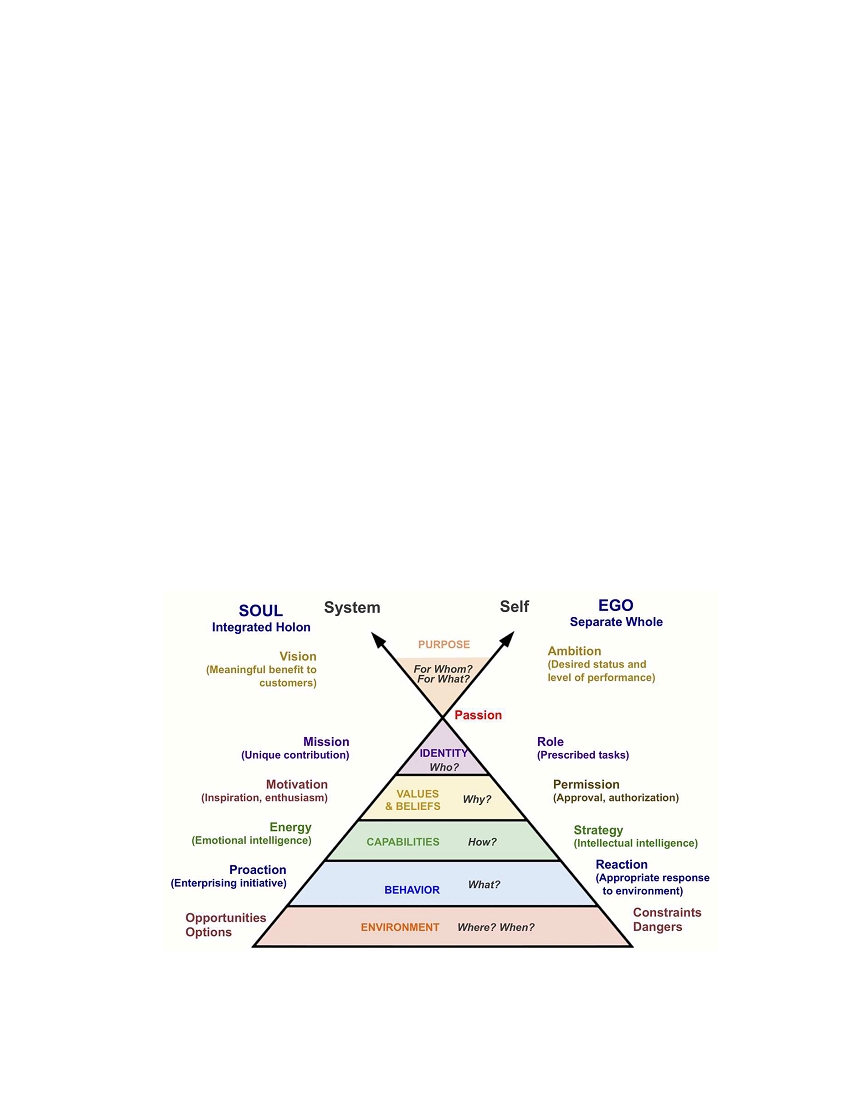
In the SFM approach, these distinctions of ego (one’s self as an independent whole) and soul
(ourselves as holons that are a part of a bigger system) are combined together with the various levels
of success factors, as shown in the following diagram.
Levels of Factors Relating to “Ego” and “Soul” in Individuals and Organizations
Next Generation Entrepreneurs: Balancing Ego and Soul – Page 2 – Copyright 2024 © by Dilts Strategy Group

The complementary dimensions of ego and soul tend to bring out a different emphasis for each
level of success factors. The ego side accentuates ambition, role, the importance of permission,
strategy and appropriate reactions to constraints and potential dangers in the environment. The soul
side puts priority on vision, mission, inner motivation and activating the energy and emotional
intelligence needed to proactively take advantage of environmental opportunities.
Research with Success Factor Modeling indicates that the highest levels of performance of an
individual, team or organization occur when the levels of success factors related to both ego and soul
are balanced, aligned and integrated. Clarifying and aligning one’s vision, mission, ambition and role
are an essential part of achieving this balance and integration. These four guideposts are the
foundations of a successful entrepreneurial mindset and form the basis for the projects and ventures
we undertake as entrepreneurs.
On a deeper level, however, our vision, mission, ambition and role are all expressions of the
fundamental life force that we bring into the world through our bodies and minds. We know and
connect to this fundamental life force through our personal sense of passion .
Ego, Soul and Organizations
The dynamic between ego and soul operates in a similar way in a company or organization. The ego
of the company is made up of the owners and shareholders, whose concern is with the survival,
financial profitability (“bottom line”) and return on investment. This is reflected by the ambition of
the organization and its members in terms of status and level of performance.
The soul of the organization is the value it provides for customers and the larger social and
physical environment. This is created by the vision of the organization and the unique contribution
and mission of the organization and its members with respect to the larger systems which it serves.
Team members and employees clearly operate in the middle of these two dimensions and need to
find the proper balance between the two in order to effectively do their jobs and serve their purpose.
When an organization leans more to the “ego” side, emphasis is more on management and
bureaucracy. Environmental constraints and dangers take priority and the company starts to focus on
reacting properly, analyzing situations correctly and following the proper plans and strategies.
Permission is required before any action can be taken and team members must stick to their
proscribed roles.
When an organization is more “soul” leaning, emphasis goes more toward leadership and
entrepreneurial activities. The environmental focus is more opportunities and proactive risk-taking is
encouraged. Energy and emotional intelligence are as much a part of guiding decision-making
process as strategy. Values related to a customer-focused vision and mission determine the priorities,
which provide the inspiration and motivation for action.
In both individuals and organizations it is important to keep a balance between the two. The
bigger your vision, the more ambition you need in order to reach it. Similarly, the bigger your
ambition, the more important it is for your vision to expand. Ego without soul creates “blind
ambition.” Soul without ego can lead to impotence and “burnout.”
Next Generation Entrepreneurs: Balancing Ego and Soul – Page 3 – Copyright 2024 © by Dilts Strategy Group
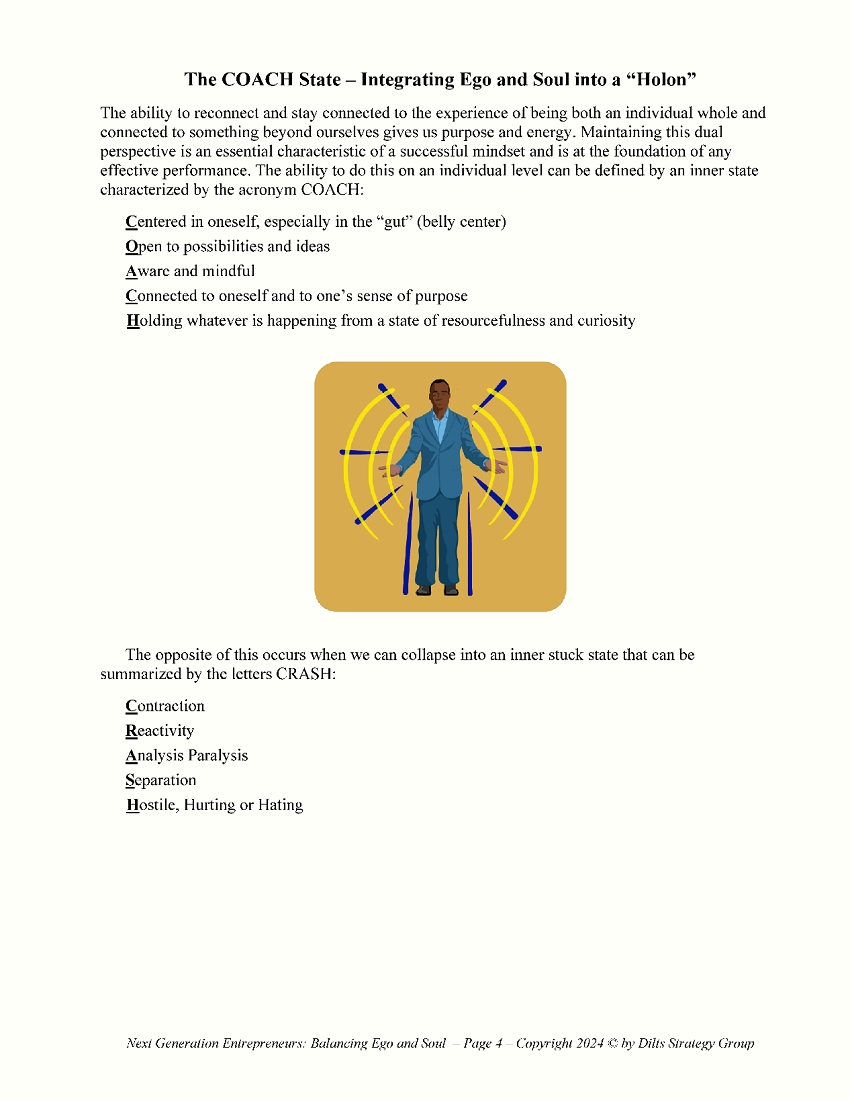

When we “CRASH,” we no longer perceive ourselves as a holon. We lose our connection to our
soul, and everything becomes more difficult. When we confront an outer obstacle from the CRASH
state, we experience it as an unsolvable problem.
Being able to achieve and maintain the COACH state, especially in difficult and challenging
circumstances, is one of the most important individual success factors defined by SFM. One
procedure to accomplish this begins by sitting or standing in a comfortable position with both feet flat
on the floor and your spine erect but relaxed (i.e., “in your vertical axis”).
1. Bring your attention to your belly center (just below the naval and in the physical center of
your body) and breathe into it.
2. Breathe into your chest and open your attention to include your whole body and your
surroundings.
3. Become aware of the three-dimensional volume of your body; then continue expand your
awareness to include the space below your feet, above your head, behind you, in front of you,
to your left and to your right.
4. Experience a sense of connection inwardly (being sure to include your head, heart, belly and
feet) and outwardly (to the Earth through your feet, to the cosmos through the top of your
head, and to the environment around you) so that you feel both being whole and part of
something larger than you.
5. Imagine projecting a sense of calm, confidence and curiosity into the space (holding
environment) you sense around you.
There are, of course, many other ways to achieve the equivalent of the COACH state. Meditation
and other mindfulness practices can lead to similar experiences of being simultaneously an
independent whole and a holon. The best approach is to find what works for you and practice it
regularly.
Next Generation Entrepreneurs: Balancing Ego and Soul – Page 5 – Copyright 2024 © by Dilts Strategy Group